



Introducing Spotnana’s AI architecture



For the past year, Spotnana has been working quietly and carefully behind the scenes to build artificial intelligence capabilities into our travel platform.
AI has tremendous potential to fundamentally change how travel is booked, managed, distributed, and serviced. While the opportunity is enormous, there are many approaches to implementing AI, and we wanted to ensure the path we took would provide the best long-term benefits for our customers and partners.
It’s easy to make an AI demo look flashy. It’s much harder to make AI highly functional, reliable, and enterprise-grade. Today we’re excited to share how we have built a new AI architecture with these principles in mind.
Taking a layered approach to AI design
It’s helpful to think about AI infrastructure for travel conceptually in four layers:
- Engagement layer – at the top of the stack is the layer that defines what a user can see and interact with. The travel industry is moving towards a conversational user experience that is consumable through an OBT and in additional channels like Slack and Teams.
- Agent management layer – once a request is received by an AI agent at the engagement layer, it needs to be broken down into tasks that are performed deeper in the stack or by a live travel agent.
- Action layer – the action layer is where tasks are performed on behalf of the user. The impact of AI is ultimately determined by the number of workflows that can be automated across different travel modalities (air, hotel, etc.) and content sources.
- Data layer – the ability of AI to make useful, accurate recommendations to a traveler and provide actionable insights is also determined by the breadth, structure, and accuracy of the underlying data. Without high quality data, AI is operating on pillars of sand.
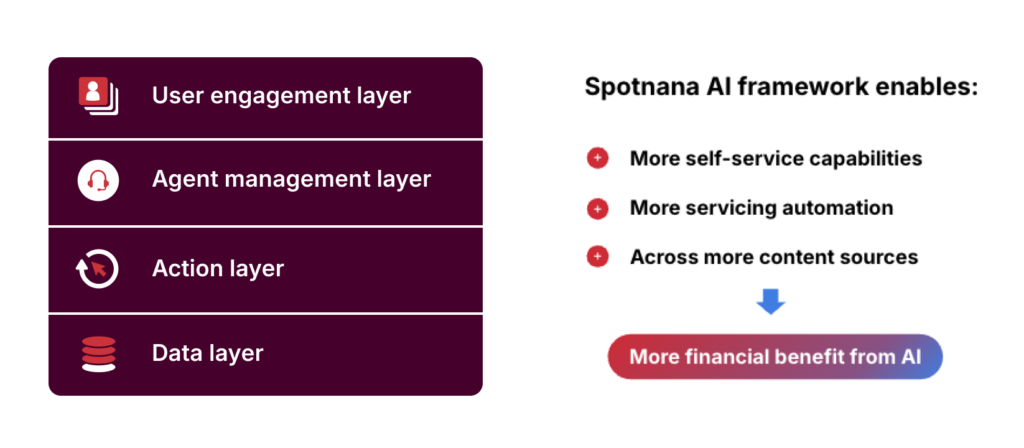
While this is a simplified way to think about AI for travel use cases, it’s useful for understanding why AI capabilities can vary tremendously across travel tools.
Spotnana found itself in a very fortunate position when AI burst onto the scene. Our travel platform was already built on entirely new, modern infrastructure that was ideally suited to unlock the potential of AI.
Because Spotnana is built around a different data model, we are able to integrate any source of content and make that content easy to book, service, and control through policies. Today we are live with dozens of content integrations, and we’ve invested heavily in automating servicing workflows across all of those content sources, so travelers can perform tasks on their own without requiring help from a live agent.
What this means from an AI perspective, is that we have a highly functional action layer and a robust data layer that AI can tap into to perform actions on a user’s behalf.
Introducing Spotnana’s multi-agent AI architecture
Building on top of that foundation, we are excited to share the work we’ve done at the orchestration layer.
Rather than relying on a single general-purpose assistant, Spotnana has built a multi-agent AI architecture that uses specialized AI agents to perform discrete tasks. Each AI agent is mapped to specific Spotnana APIs that execute deterministic workflows, resulting in a high degree of accurate, autonomous action.
In our architecture, an AI agent can never invent a refund amount, a fare rule, or a travel policy—it can only execute the same governed operations a human would take using the same structured data and automated workflows.
A single AI orchestration agent organizes the work of individual sub-agents by routing requests and defining a sequence of actions. Users are required to confirm any action that requires a financial transaction.
Spotnana’s new AI architecture is open by design. Our customers and partners can develop their own AI agents and integrate Spotnana’s AI capabilities with other systems, including internal AI tools.
Using our new AI architecture to automate servicing workflows
Today we announced two AI agents in our multi-agent architecture focused on servicing:
- AI agent for servicing tasks – Automates high-volume, routine servicing tasks including handling cancelled segments that result from airline schedule changes, validating unticketed airline segments, issuing residual MCOs (miscellaneous charges orders), and automating refunds.
- AI agent for external bookings – Automatically brings externally booked trips into the Spotnana platform.
These AI-agents help live agents spend more time delivering personalized service and less time executing repetitive tasks. More information is available in the blog we posted today, titled Unlocking the power of AI for travel agents.
Today’s announcement is just the beginning
Over the coming months, we’ll continue expanding AI capabilities for travelers, travel managers, and travel agents—all built on the same extensible AI architecture.
We believe the greatest opportunity for AI in travel isn’t simply better conversations. It’s intelligent automation embedded throughout the travel platform that helps organizations reduce costs, improve service, and deliver better travel experiences at every stage of the journey.
Want to learn more about how Spotnana’s modern infrastructure can transform your business? Request a demo today.
Written by

-
 Unlocking the power of AI for travel agentsTravel agents spend a significant portion of their day handling repetitive operational tasks that are essential to servicing travelers but don't require human judgment. These tasks consume valuable time that could otherwise be spent...

-
 Spotnana builds direct integration to TravelodgeBudget accommodation has long been a challenging segment in corporate travel. While business travelers across the UK and Europe need access to affordable, quality hotels, traditional platforms have struggled to deliver the rates, content,...