



Delivering a new level of flexibility for travel managers



Travel managers often feel boxed in. Their travel programs have specific requirements, but their online booking tools (OBT) lack the flexibility to meet their needs.
Whether it’s a desire to access new content sources, implement the optimal travel policy, capture specific data from custom fields, apply the best payment method, or tailor dozens of other aspects of their travel program, too often travel managers are expected to conform their programs to the limitations of their OBT.
Spotnana strives to take the opposite approach. We provide much more than an OBT. Our Travel-as-a-Service platform is designed from the ground up to be flexible and configurable, with extensive self-service controls that put travel managers in charge.
The flexibility challenge with traditional platforms
It’s helpful to understand why traditional OBTs struggle with flexibility.
Outdated infrastructure. OBTs are simply a user interface for creating and managing a booking. If the infrastructure they are built upon has a limitation, then they have this limitation, too. For example, traditional booking tools rely on unstructured text files called PNRs (Passenger Name Records) to manage bookings. The scripting tools required to process these text files make it difficult for TMCs to support new content sources or automate complex workflows.
TMCs and corporations run on different systems. The technology a TMC uses to service bookings is separate from traditional OBTs. This means that new capabilities in an OBT might not be usable until TMCs update systems on their side. Many configuration changes require actual development work like updating scripts, modifying code, and building custom processes. This is time-consuming, expensive, and creates a backlog of requests.
Hard coded logic. Traditional OBTs typically build a feature one hard coded rule at a time. Take policy management, for instance. Legacy systems often support basic static policies like “economy only” or “hotels under $200/night” but struggle with the nuanced, dynamic rules that large global programs require. Travel managers have to fight for space on the roadmap and then wait for their OBT to hard code the specific rule they need.
Fragmented global deployments. Many traditional online booking tools deploy separate software instances for different countries or regions. Making a policy change means updating each deployment individually, creating inconsistency and administrative burden across your global program. TMCs may also use an array of affiliate agencies to manage travel in various countries, further increasing fragmentation.
The result? Travel managers spend countless hours working around platform limitations and waiting for changes to be made, rather than optimizing their programs.
Spotnana’s approach: Your program, your rules
Spotnana’s Travel-as-a-Service platform is built on a fundamentally different philosophy. We believe technology should adapt to your travel program, not the other way around.
This is enabled by five architectural decisions:
Modern infrastructure: Spotnana has built new infrastructure for the travel industry from the ground up, allowing us to greatly increase flexibility for travel managers. We have developed our own System of Record for travel, and we do not rely on PNRs to create or manage bookings. This frees us from the limitations of managing data through text files instead of databases. Our Content Engine works with any source of content, making it simple to add new suppliers and build a richer travel shopping experience without lengthy development cycles.
Unified platform for travelers and agents. Spotnana’s travel platform includes all of the core technology that a TMC uses for servicing including agent task management, mid-office automation, rate code management, and more. Because travelers and agents use the same platform, everyone sees the same information, and all new features are rolled out to everyone at once. We eliminate the ability for the TMC and the OBT provider to point fingers at each other, because everyone uses the same technology.
Microservices architecture. Instead of a monolithic code base, Spotnana uses microservices that can be orchestrated in different ways to support a wide range of complex workflows. We also design our features with rule engines that use dynamic code building instead of hard coded logic. For example, with our travel messaging feature, travel managers can define the audience that receives a custom email or sees a message in the OBT by using an interface to build dynamic rules with a few clicks. This means we can support extremely sophisticated configurations without requiring extensive developer time.
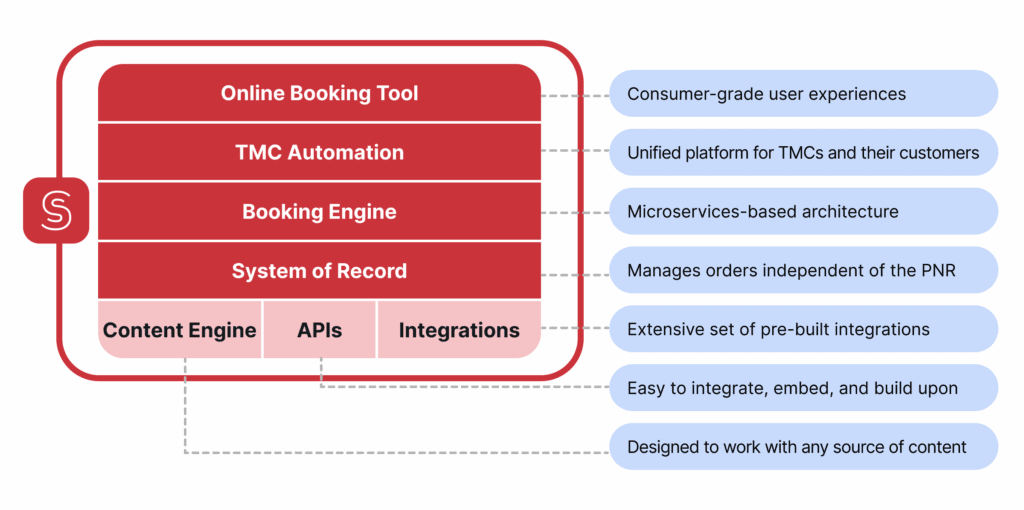
Single global instance. Spotnana deploys as one global software instance, not separate regional deployments. A policy change made in the admin console instantly applies to all travelers and agents worldwide.
Open, API-first platform. Spotnana is designed to be extended and used as a foundation that others can build upon. Every component of Spotnana is built with an API, and our user interfaces are built as an independent layer. This separation allows us to iterate independently on back-end functionality and front-end design. Our customers and partners can also access our open APIs through our developer portal and integrate Spotnana with any other system they choose.
Just as the performance of a car is determined by its engine, the architecture we’ve built under the hood is what gives our customers unprecedented flexibility with real-time control.
The power of real-time changes
The power of Spotnana’s flexibility becomes even more clear when you need to make urgent changes.
Travel disruption response. When severe weather or geopolitical events impact travel, you can instantly adjust policies, add site messages, restrict affected destinations, and modify approval workflows. Changes are immediately visible to all travelers and agents.
Budget adjustments. When fiscal constraints require immediate cost controls, you can tighten policy thresholds, add approval requirements, or restrict certain suppliers in minutes rather than days or weeks.
Supplier changes. When a supplier loses preferred status or you negotiate a new corporate rate, update it once and the change is immediately reflected for all travelers worldwide.
Payment method updates. Adding a new virtual card, updating payment assignments, or changing invoicing details takes effect instantly across your global program.
Because travelers and agents work on the same platform, they always see consistent, current information. There’s no confusion, no version mismatches, no “wait until tomorrow for the changes to take effect.”
Built for the world’s largest programs
Enterprise-scale travel programs have requirements that smaller programs don’t face:
- Hundreds of policy variations across departments, regions, and job levels.
- Complex approval hierarchies and delegation rules.
- Multiple legal entities with different payment methods and compliance needs.
- Diverse traveler populations including employees, contractors, candidates, customers, and guests.
- Advanced integration requirements with HR, expense, ERP, and other enterprise systems.
Spotnana is purpose-built for this complexity. Fortune 500 organizations trust Spotnana to power their global travel programs because our platform can handle their specific requirements without forcing compromises.
This flexibility extends to deployment as well. You can launch multiple countries simultaneously rather than rolling out one region at a time. A single admin console manages your entire global program with consistent policies, instant visibility, and unified reporting.
Run your program your way
For too long, travel managers have been constrained by platforms that couldn’t adapt to their programs’ needs. The result has been compromises, workarounds, and wasted time.
Modern travel technology should empower you to run your program exactly the way you need to run it. Policies should reflect your business requirements and platform capabilities together. Changes should happen in real time. Configuration should be self-service, with travel managers in direct control.
This is how we are building Spotnana. Our Travel-as-a-Service platform already gives you unprecedented flexibility, and we’re constantly adding more capabilities with rich configuration options for travel managers to deploy. AI is accelerating this, and it will soon be possible to configure policies and other parts of our travel platform by using natural language to describe what you want.
Our belief is simple. Your travel program is specific to your organization. Your technology should adapt to it.
Ready to see how Spotnana’s flexible platform can transform your travel program? Request a demo and experience real-time configurability firsthand.
Written by

-
 Stealth travel limits visibility to those who need to knowCorporate travel can be highly sensitive. Perhaps a CEO needs to meet with a board candidate, or a mergers and acquisitions team needs to negotiate a deal in person without spreading rumors. If travel...

-
 Role-based access control supports tailored permissions for each userIt takes a village to run a travel program. Within a corporation there can be one or more travel managers, key stakeholders across finance and HR teams, and a wide range of specialized users...