



Podcast: How Kyte connects airlines with the travel ecosystem


Low-cost carriers are among the world’s largest airlines, yet accessing their content through modern APIs has historically been a challenge for corporate travel platforms and TMCs.
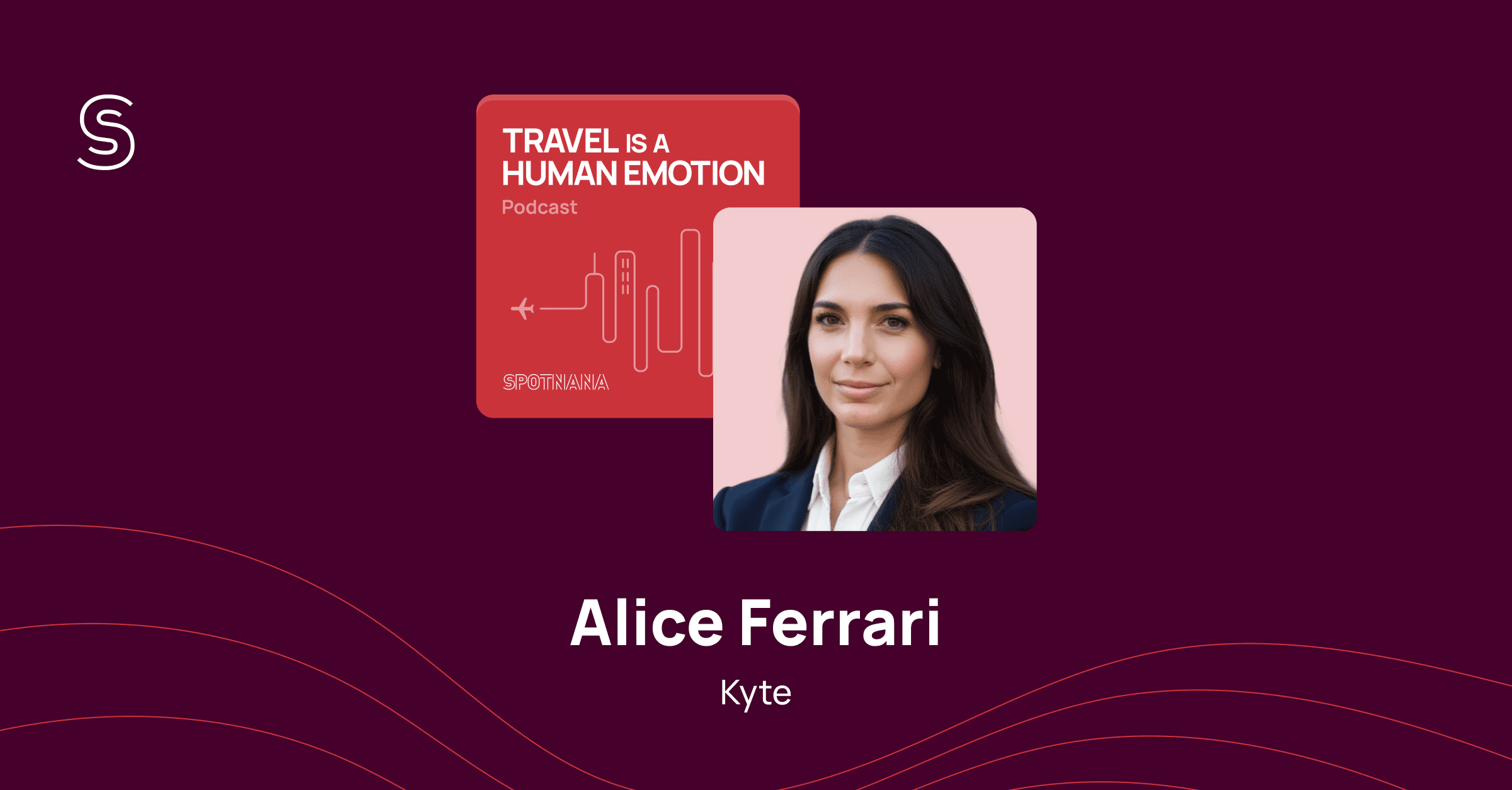
For the 18th episode of The Travel Is a Human Emotion Podcast, Spotnana’s Senior Director of Content and Distribution, Seth Anagnostis, spoke with Alice Ferrari, CEO and co-founder of Kyte, to discuss how her company is bridging this gap and what it means for the future of airline distribution.
Ferrari detailed Kyte’s unique approach to airline connectivity, the evolving dynamics of low-cost carrier distribution, and how the partnership with Spotnana brings travelers seamless access to carriers like Ryanair and easyJet.
Connecting airlines with the travel ecosystem
Kyte describes itself not as a traditional aggregator, but as a platform connecting airlines with the broader travel ecosystem. The distinction is important.
“We try to differentiate ourselves from the traditional aggregator simply because whilst there’s some great aggregators out there, generally the aggregator perception has been to put together a mishmash of content,” Ferrari explained. “We’re extremely focused just on airlines and only connecting to airline APIs directly.”
The company was founded nearly six years ago, emerging from Ferrari’s background in aviation and her work at Founders Factory, a London-based venture studio with EasyJet as a strategic investor. The timing was challenging, as Kyte launched just before the pandemic, but Ferrari sees a silver lining.
“The pandemic has really accelerated the adoption for NDC and API distribution,” she said. “In hindsight, it has actually promoted a solution like Kyte.”
Quality over quantity
What sets Kyte apart is its focus on delivering end-to-end functionality rather than simply maximizing the number of airline connections. Each airline integration takes between four to six months for low-cost carriers, and up to eight to ten months for full-service airlines.
“Every API is different, whether it’s an NDC API, whether it’s low-cost NDC, whether it’s proprietary,” Ferrari noted. “There is really no standard API, no matter who’s built it and how they’ve built it.”
This investment in quality resonates particularly well in the corporate travel space, where incomplete functionality is a non-starter. Kyte’s platform supports the full booking journey, including ancillaries, bundles, and post-ticketing functionality.
The low-cost carrier opportunity
Low-cost carriers have traditionally maintained a direct distribution strategy, but that’s evolving. As these airlines expand into new geographies and market segments – including corporate travel – they’re increasingly open to third-party distribution.
“Low-cost airlines are growing significantly,” Ferrari observed. “They’re looking at other geographies, other market segments, for example corporate travel, and thinking, well, how do we capture this type of market?”
The numbers support this shift. Ryanair is Europe’s largest airline, and low-cost carriers often provide essential connectivity to primary airports that full-service airlines may not serve as comprehensively.
Kite currently works with 12 live airlines on its platform, with a focus on quality integrations that include all the functionality travelers expect. The company recently announced new low-cost airline partnerships, continuing its mission to make these carriers easily accessible to corporate travel platforms.
As a two-sided marketplace, Kyte must balance its investments between airline partnerships and distribution channels. Ferrari said the company has reached a critical mass of airline content that makes the platform appealing to travel companies, allowing Kyte to focus more heavily on the demand side.
“We are mainly focusing on the travel partners,” she explained. “Even if we have 12 airlines today that are live, the fact that we have an end-to-end solution makes it a valuable solution so that many travel companies will switch to us for those particular airlines.”
The partnership with Spotnana
Spotnana’s connection to Kyte brings low-cost carrier content – particularly Ryanair and EasyJet – to corporate travelers through APIs that are easy to integrate and provide comprehensive functionality.
“What I love about Spotnana is you’re driven by perfection,” Ferrari said. “There has been rigorous testing before you put our content live to your customers. The greatest part about Spotnana is the UI, the rich content. Travelers really feel like they have all the options and all the functionalities in one tool.”
For Spotnana, the partnership addresses a critical area. Low-cost content is essential for providing comprehensive options to travelers – regardless of whether it fits into traditional distribution categories.
“Corporate travel companies really value the depth of the content,” said Ferrari. “There’s a lot of transparency from Spotnana’s UI. It really makes the traveler feel like they’re not missing out by not booking on the airline’s website.”
Looking ahead: Offers and orders
When asked about the industry’s transition to offers and orders, Ferrari expressed enthusiasm tempered with pragmatism. While she sees massive opportunities in dynamic pricing and personalized bundling, she’s skeptical about low-cost carriers adopting NDC standards wholesale.
“NDC should be a concept and not a standard because the industry needs to keep evolving,” she argued. “It feels a bit like a regression when low-cost airlines look at what full-service carriers are doing.”
Instead, Ferrari envisions Kyte playing a role in helping airlines create more dynamic bundles based on traveler data and preferences – offering perhaps 20 different bundle options rather than the standard two or three, with the right bundle presented to the right customer at the right time.
Travel as a human emotion
When asked about the connection between travel and human emotion, Ferrari reflected on what drew her to the industry in the first place.
“My mom used to work for our national carrier in Italy, and from my early days, 30 years ago, I was exposed to this industry,” she shared. “I love watching people at arrivals when they hug as they see each other. And I always think how amazing it is to be part of it and to be contributing towards that. It just makes me very emotional.”
It’s that emotional connection that drives both companies’ missions – ensuring that whether travelers are booking for business or leisure, whether they’re flying low-cost or full-service, they have access to the best possible experience and options.
Written by

-
 Podcast: ZS Associates’ multi-channel travel programMost corporate travel programs force travelers to book through an online booking tool (OBT). ZS Associates takes a different approach. The professional services firm, which operates more than 35 offices worldwide and runs an...

-
 Stealth travel limits visibility to those who need to knowCorporate travel can be highly sensitive. Perhaps a CEO needs to meet with a board candidate, or a mergers and acquisitions team needs to negotiate a deal in person without spreading rumors. If travel...