




AI workflows are the new rails for travel



Every industry eventually faces a reckoning with its infrastructure. After a critical mass of innovation builds up, a wave of digital transformation inevitably follows.
For decades, travel has been powered by aging systems like PNRs, queues, and green screens that were never designed for the complexity of today’s fragmented content landscape or the level of personalization and proactive service today’s travelers demand.
The future of travel will be defined by durable, intelligent workflows that can be executed reliably by AI agents across airlines, hotels, payments, policies, and servicing teams.
From records to workflows
In the SaaS era, relational databases and cloud computing became indispensable infrastructure layers. You couldn’t build Salesforce without a durable store of state. In the AI era, the indispensable layer is durable workflows: systems that ensure an end-to-end process runs reliably, with retries, handoffs, and preserved context. This is essential for agentic AI tools to successfully take action on behalf of a traveler.
Travel has been missing this layer for decades. Every journey is, in reality, a workflow:
- Searching for flights across multiple travel providers.
- Validating fare rules, corporate policies, and traveler preferences.
- Confirming bookings and synchronizing with expense tools, duty-of-care providers, and other third-party systems.
- Servicing changes, disruptions, or cancellations in real time.
Historically, each of these steps has been stitched together with brittle glue code, requiring manual intervention to overcome the limitations of siloed systems. This is a key reason why travel feels so fragmented.
Why workflows matter in travel
For travelers to experience truly seamless journeys, workflows are essential. Data is fragmented across a wide range of entities, and each trip can have a tremendous amount of variability and complexity:
- Multi-step: A single itinerary can touch 10+ travel providers and internal systems.
- Stateful: Trips span months; disruptions can happen anytime, so it’s crucial to retain context.
- Failure-prone: Cancellations, weather, policy mismatches, and payment declines are common.
- Global and concurrent: Millions of journeys unfolding in parallel produce constant edge cases.
Without a durable workflow engine underneath, every disruption turns into a service failure, every change into a call center ticket, and every personalization requires a one-off hack.
The future Spotnana is building
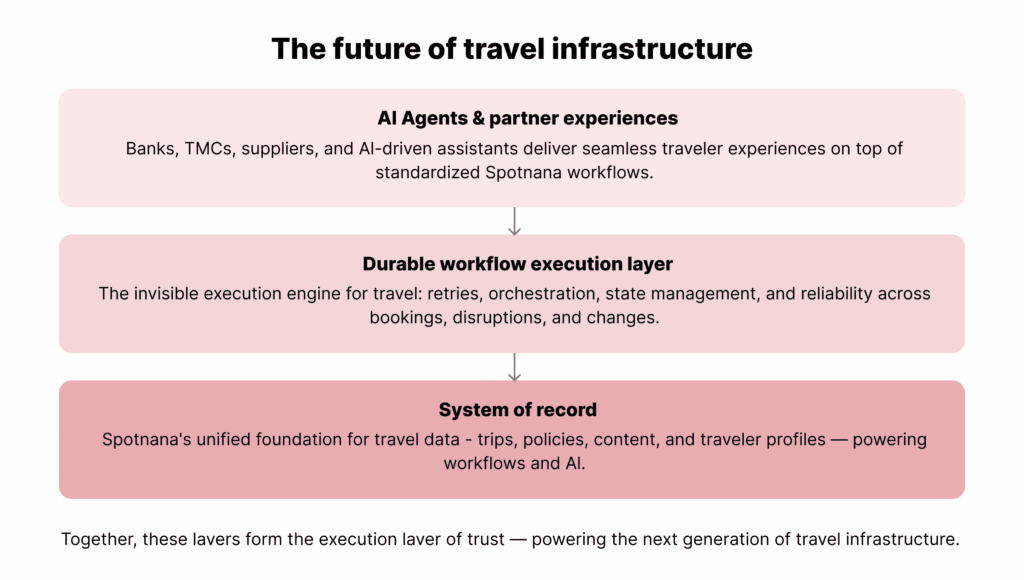
At Spotnana, we’ve reimagined travel from the ground up. Our System of Record now gives the industry a durable foundation for travel data.
The next step is building the workflow rails for travel – an execution layer that ensures every search, booking, change, and servicing event runs to completion, across travel providers and partners, with transparency and high reliability.
This is where AI and workflows converge. An AI agent that rebooks a traveler when a flight is canceled is orchestrating a workflow:
- Detect the disruption.
- Pull updated inventory and fares.
- Extract fare rules and waiver code from airline email.
- Apply corporate policies, fare rules, and waiver code.
- Identify the next-best offer.
- Hold the new booking and notify the traveler.
- Confirm the new booking when confirmed by the traveler.
- Sync with expense tools.
- Escalate to a human if conditions fail.
A durable workflow needs persistence, retries, and context that survives across systems. This is the invisible layer of infrastructure that Spotnana is building.
Why this matters for the industry
Just as no one builds their own proprietary database anymore, no travel company should need to build brittle workflows to overcome the limitations of siloed legacy systems.
Spotnana’s infrastructure will allow travel providers, TMCs, banks, and technology partners to tap into standardized, durable travel workflows that accelerate innovation, reduce operational costs, and create better traveler experiences.
In five years, I believe we’ll look back on workflows in travel the same way we now look at relational databases in SaaS – invisible, indispensable, and the foundation upon which the next generation of travel experiences is built.
Written by

-
 Podcast: Eric Bailey on purposeful travel, transparency, and trustEric Bailey managed Microsoft's travel program for nearly 20 years, overseeing spend that at one point exceeded $1 billion, and used his position to push the wider industry forward. Seeing an industry drifting on...

-
 Introducing a richer seat experience in SpotnanaChoosing the right seat makes a meaningful difference to a traveler’s journey. Travelers want to know where a seat is on the aircraft, what features it offers, and how its experience compares with other...