



The new travel manager
Travel managers in 2026
The travel manager role has evolved more in the last few years than in the entire decade of the 2010s. Everything has changed: the definition of the travel manager role, how far its scope reaches, and how the people who manage travel are judged. Travel and expense (T&E) sits among the top three expenditures at most companies, alongside payroll and rent, which is why travel managers are routinely pulled into conversations with corporate finance, procurement, and data analysis teams.
Global travel programs have become harder to manage as complexity has increased. 61% of travel buyers now call managing a global program a major or moderate challenge, according to 2026 research from GBTA and Spotnana. For the first edition of Spotnana Viewpoints, we spoke with seven corporate travel managers who work across pharma, tech, manufacturing, logistics, and consulting about how the role has shifted, what they wish more stakeholders understood, and what advice they would give someone entering the field today.
Interviewed for this story
Michelle Amos is Associate Director of Travel, Expense and Corporate Card at Qualtrics, managing a roughly $20 million global program after years handling large corporate accounts on the agency side.


Interviewed for this story
Suzanne Boyan is Global Meetings and Travel Manager at ZS Associates and BTN’s 2019 Travel Manager of the Year. She moved from luxury hotel operations to build the consulting firm’s travel program from scratch.

Interviewed for this story
Fazal Choksi is Director of Indirect Procurement and Global Head of Travel at Ciena and a 2025 Business Travel News Best Practitioner, recognized for moving the networking company’s travel program to a smaller, more agile technology partner.

Interviewed for this story
Pete Crow is Global Travel and Expense Manager at PACCAR, maker of Kenworth and Peterbilt trucks. He came up through State of Washington travel and seven-plus years as an agency account manager.

Interviewed for this story
Ann Dery is Director of Global Category Lead for Travel, Meetings & Events at Johnson & Johnson and BTN’s 2021 Travel Manager of the Year, an honor earned at S&P Global before her 2023 move to J&J.

Interviewed for this story
Lela Loudou is Global Head of Travel at Kuehne + Nagel, the global logistics company. She is active in European travel manager networks, tracking where the business is heading.

Interviewed for this story
Steve Sitto is Senior Director of Global Procurement for Travel, Events, Fleet & Payments at Regeneron and BTN’s 2024 Travel Manager of the Year, after building programs at Cisco, Genentech, GE, Tesla, and Gilead.

From operations to strategy
For years, the travel manager role involved managing booking logistics and enforcing policy. It took a lot of effort to wrangle a combination of traditional travel management companies (TMCs), online booking tools (OBTs), and travelers choosing to go rogue by booking on consumer sites.
Most of the travel managers described that “police officer” version of the role as something they are glad to have left behind. Their focus has shifted toward finance, procurement, and data, where being responsible for one of the top-three expense lines makes the travel manager an important figure in strategic business conversations.
Michelle Amos, Associate Director of Travel, Expense and Corporate Card at Qualtrics, stressed the strategic importance of the travel manager role to the wider organization. “You not only are strategic in travel, you have to be strategic in business,” she said.
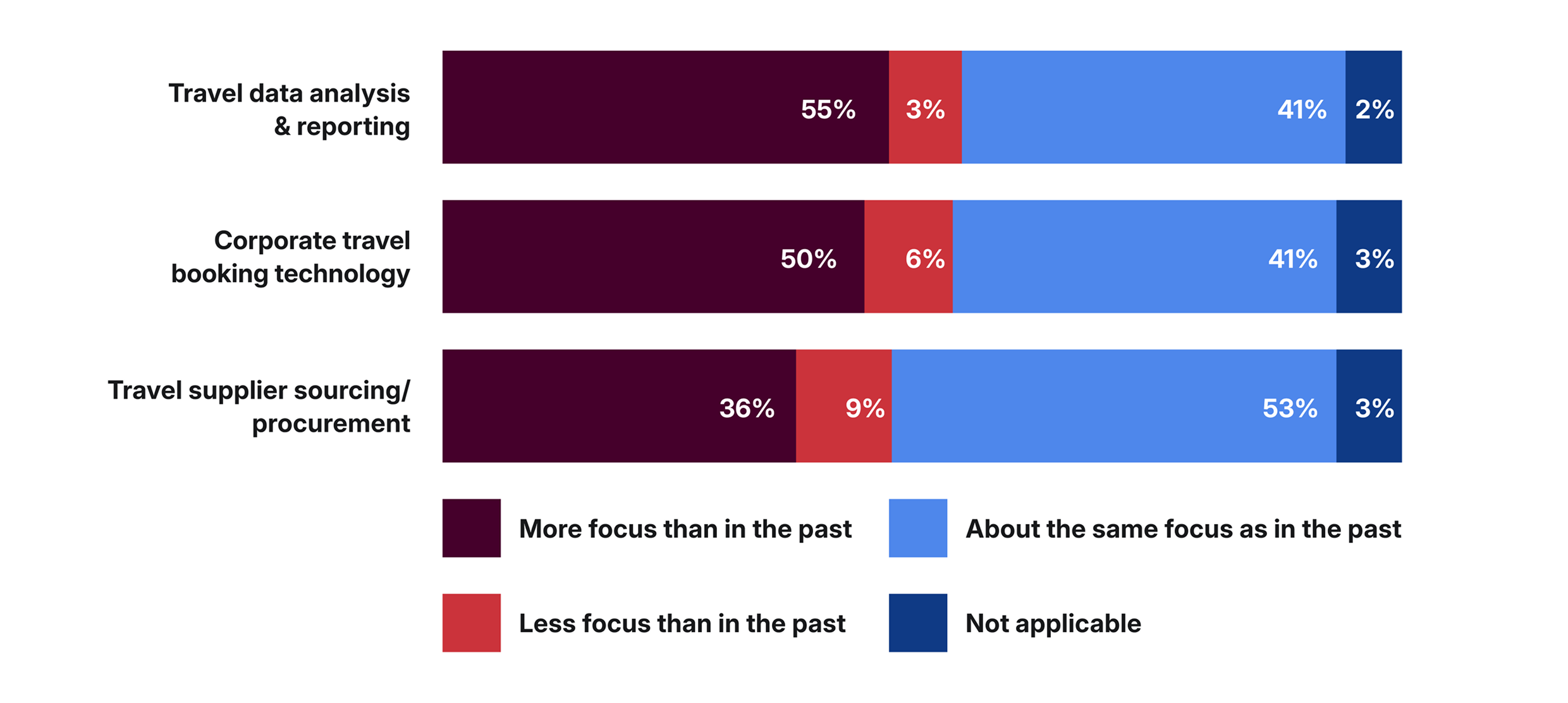
Travel managers, however, haven’t always been asked to be strategic thinkers. Most of the people we interviewed started their careers in an operations-first version of the job and watched the scope widen around them.
Ann Dery, Director of Global Category Lead for Travel, Meetings & Events in Johnson & Johnson’s Global Services Procurement, watched that scope widen firsthand throughout her career.
“We went from somewhat of a revenue-generating cost center back in the day to a full-blown cost center,” she said. “We’ve had to learn quickly how to pick up a skill set we didn’t have initially, especially data augmentation, because everybody’s looking for insights, and it’s very hard to pull insights when you don’t have well-cleaned, organized data to work with.”
Part of embracing a strategic mindset involves fighting the misconception that anyone can do a travel manager’s job, since travelers book leisure trips and assume corporate travel is the same, just at scale. Several travel managers said explaining the difference is a key part of their role.

Ann Dery, Director of Global Category Lead for Travel, Meetings & Events, Johnson & Johnson
Lela Loudou, Global Head of Travel at Kuehne + Nagel, argues that expertise should decide who signs off on a trip. “Often the line manager approving travel doesn’t have an idea about travel, they just press the approve button,” she said. “Why don’t you leave it with a travel office that knows the options and offers better?”

Steve Sitto, Senior Director of Global Procurement for Travel, Events, Fleet & Payments, Regeneron
Steve Sitto, Senior Director of Global Procurement for Travel, Events, Fleet & Payments at Regeneron, traced the perception of travel as an operational role back to every travel manager’s goal of reducing friction for travelers. “The misconceptions come from our inability to articulate our value,” he said. “You’re so good at what you do that you forget to highlight the complexity of the program; you have to show them under the hood.”
Sitto once shocked his head of procurement by showing how passenger name records (PNRs) work, line by line. Exposing stakeholders to the complexity caused by travel’s legacy technology infrastructure or agent-backed servicing regime can help build credibility for the idea of bringing modern corporate travel solutions into a travel program.
“My old boss said sometimes you have to let things break to get their attention, and it is very true,” Sitto continued. “But the best move is to be transparent.”
The way buyers evaluate their partners shows a newfound focus on technology. When choosing a new travel management company (TMC), buyers now weight technology slightly above servicing, 54% to 46%, according to 2026 research from GBTA and Spotnana.
Modern technology is empowering travel managers to provide a stronger, more targeted array of insights to stakeholders without weeks or months of data processing. Pete Crow, Global Travel and Expense Manager at PACCAR, frames this evolution around data discipline that mimics the wider data-driven approach of larger corporations.
“If all we were doing was throwing travel data at stakeholders, 95% of which had zero impact on their decisions, we weren’t adding value. We were just polluting their workday with noise,” he said. Partnering with stakeholders to surface the numbers that help inform their decisions is now crucial.
Value vs. cost
Cost always mattered, but traveler value and well-being now sit alongside cost in importance to stakeholders. The best travel programs are balancing all three.
Financial pressure has increased alongside shifts in the global economy that have increased air fares and hotel rates. 72% of buyers say the biggest hotel booking pain point is travelers saying “I found it cheaper somewhere else,” and the average self-reported leakage rate sits at 32%, according to 2026 research from GBTA and Spotnana.

Lela Loudou, Global Head of Travel at Kuehne + Nagel
Loudou described that balancing act as the core of the job, particularly in recent years with travel disruptions and cost increases caused by the pandemic and Middle East conflict.
“We are being called to bring the balance between the organization and the traveler,” she said. “Cost efficiency, then well-being. They have even invented some new policies for this, giving an extra day when they fly economy instead of booking in another higher class.”
Even so, focusing on price alone ends up missing the importance of traveler experience and the business value it can help drive.
When a conversation on travel spend focuses on price alone, Crow focuses on the value provided to the traveler. “I like to pivot the conversation to: let’s take a look at what you are able to spend and get the most out of that trip,” he said. “Is saving $5 or $10 a booking worth the frustration that comes from lower service or lower quality tools?”
The booking and servicing experience has become a lever for both cost and value at once. When the tools work, travelers feel taken care of. When they don’t, they book outside of policy.
Suzanne Boyan, Global Meetings and Travel Manager at ZS Associates, offered a case where the balance paid off. She once rerouted a traveler through a snowstorm so he could make it home in time for his daughter’s birthday.
“He was able to accomplish his work goal of meeting with his clients, but also his personal goal of being a present dad,” she said. “Both of those can live in harmony together through a really high-tech travel program.”
Delivering that balance at scale depends on the tools that power travel programs underneath the hood.

If all we were doing was throwing travel data at stakeholders, 95% of which had zero impact on their decisions, we weren't adding value. We were just polluting their workday with noise.
Pete Crow, Global Travel and Expense Manager at PACCAR

AI and relationships
The rise of artificial intelligence (AI) is dominating the industry conversation right now, and the travel managers we spoke with responded with a combination of healthy skepticism and excitement for enhancements to their travel programs.
The data suggest the industry is still early in terms of adoption: 58% of buyers say AI has had little or no impact on their program so far, and only 12% rated the impact as 4 or 5 out of 5, according to 2026 research from GBTA and Spotnana.
Several interviewees pushed back specifically on the chatbot and booking-bot hype filling LinkedIn feeds and conference stages, while staying optimistic about foundational improvements happening behind the scenes.
Loudou was the bluntest. “Chatbots are the biggest nonsense ever,” she said. “The real efficiency lies in areas like analysis and research, requiring access to data in a protected environment.” Overall buyer interest backs her up.
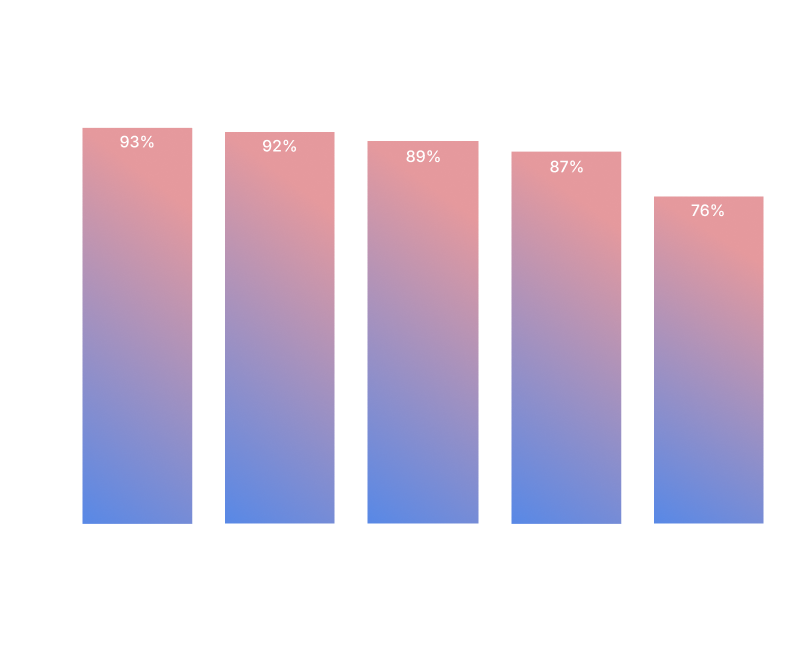
Reporting and analytics top the AI wish list, with operational use cases close behind. 93% of buyers are interested in AI for report creation, 92% for predictive analytics on spend, and 89% for automated trip disruption management and rebooking, according to 2026 research from GBTA and Spotnana.
Dery put the hype in perspective with a comparison to another long-promised technology. “I like to think of AI as the new NDC,” she said. “We’ve been talking about NDC for 10 years and we’re still trying to get it to work. At least now we’re talking about something else.”
The payoff from back-end work is beginning to show up in traveler experience, with the technology working in the background. A disruption rebooked automatically, a corporate card flagged before expiration, a spend forecast that requires no manual cleanup; each removes friction without the traveler ever interacting with AI directly.
As AI automates repetitive tasks, relationships remain vital to bringing together a cohesive travel program. Boyan drew the line clearly. “Anything that is hyper process-oriented is ripe for disruption from AI,” she said. “It is the strategic leverage that you bring through your relationships, and through the integration of technology and data storytelling, that AI will have a harder time disrupting.”
Relationships with partners kept getting named as core to providing the best possible experience to travelers, particularly in an era of increased automation. Boyan said her network that gets things done doesn’t appear only on the ZS Associates org chart.
“When I refer to my team, I don’t mean only internal employees,” she continued. “My team is my hotel reps, my airline reps, my TMC account manager, my booking tool account manager, my corporate card account manager.”

Fazal Choksi, Director of Indirect Procurement and Global Head of Travel, Ciena
Feedback from travelers and stakeholders remains vital to improving travel programs and ensuring travelers have a positive experience.
Fazal Choksi, Director of Indirect Procurement and Global Head of Travel at Ciena, uses a monthly standing meeting to keep the traveler’s voice in the room. “We’ve got a travel council with sustainability, security, travel arrangers, global mobility, and we invite road warriors,” he said.
Even the most advanced program runs into issues that no single travel manager can fix, especially without timely feedback from end users and stakeholders.
Anything that is hyper process-oriented is ripe for disruption from AI. It's the strategic leverage you bring through relationships that AI will have a harder time disrupting.
Suzanne Boyan, Global Meetings and Travel Manager at ZS Associates

Missing transparency
Revenue-model transparency came up unprompted from multiple travel managers. The ambiguity of how TMCs, OBTs, and travel providers make money, they said, gets in the way of an honest conversation between buyers and partners.
Buyers increasingly want these issues discussed publicly, rather than remaining the elephant in the room during negotiations.
Choksi made the case sharply. “There is no transparency in terms of the revenue structure,” he said. “We know that the TMCs and the OBTs are getting a cut [of supplier revenue], and we don’t know what that is. You need to make money, for sure, I don’t have an issue with that. But should it be at the expense of the people who are actually buying those services and goods?” He framed the setup as a possible conflict of interest.
The same opacity bleeds into supplier negotiations, where buyers feel they are owed data on the money changing hands based on their spending. Choksi said airlines will not share what they pay TMCs and OBTs even when he asks directly, despite his organization buying the tickets.
The stakes go beyond line-item math. Supplier relationships are what travel managers fall back on when a program is under pressure, and that goodwill is hard to bank when the financial transparency only runs one way.
Dery described the value of maintaining strong relationships with suppliers. “Without that supplier network and those relationships that have been built up over the years, when you really need your supplier to go above and beyond, it’s hard to ask,” she said. “But when you do have those relationships, it can facilitate a lot.”
Advice for the up-and-coming travel manager
The advice these seven offered for someone stepping into the role landed in two camps. The first was patience: learn how corporate travel really works before trying to change a program.
Crow made the case against arriving with a set of predetermined program fixes. “Resist the urge to prove your worth by bringing in some kind of change early,” he said. “First and foremost, get an idea of what the company culture is like and what kind of value-add your role is expected to have. Don’t go into a new role with a preconceived notion of what that value-add is going to be.”
Amos echoed the theme with a tactical move: she had her team sign up for the BTN daily newsletter and read every article for the first month, then get involved in a local GBTA chapter early. Dery added that any business case for change has to be built around what the business needs, with the end user front of mind.
Part of the case for patience is that the ecosystem is more tangled than newcomers expect. Boyan learned that through experience.
You are not only strategic in travel, you have to be strategic in business.
Associate Director of Travel, Expense & Corporate Card, Qualtrics

“The ecosystem is a puzzle,” she said. “It wasn’t until I was a few years in that I realized how absolutely insane the ecosystem is in order to make corporate travel work. Without the basic understanding of it, anything else is really difficult, and I do think [educating new entrants is] one thing our industry doesn’t do very well.”
The second camp discussed the importance of relationships. Once you have your bearings, the relationships in and around the program provide the widest range of benefits, and Choksi described travel management as a relationship business rather than a purely technical or analytics.
Sitto offered the most specific version of the advice. “Your relationships matter the most,” he said. “A couple of things: don’t take it personal, this is business. And learn how to communicate with stakeholders early on. Go after the ones you may not hear from, people that seem kind of removed but actually control your global payments program. They could be your biggest ally.”
Across all seven interviews, the through line is consistent. The travel manager role has grown more strategic, more accountable to traveler value, and more dependent on relationship-building. The tools that power travel programs will continue to evolve, but what holds a travel program together is people.
Written by
