



How to eliminate “I found it cheaper somewhere else”


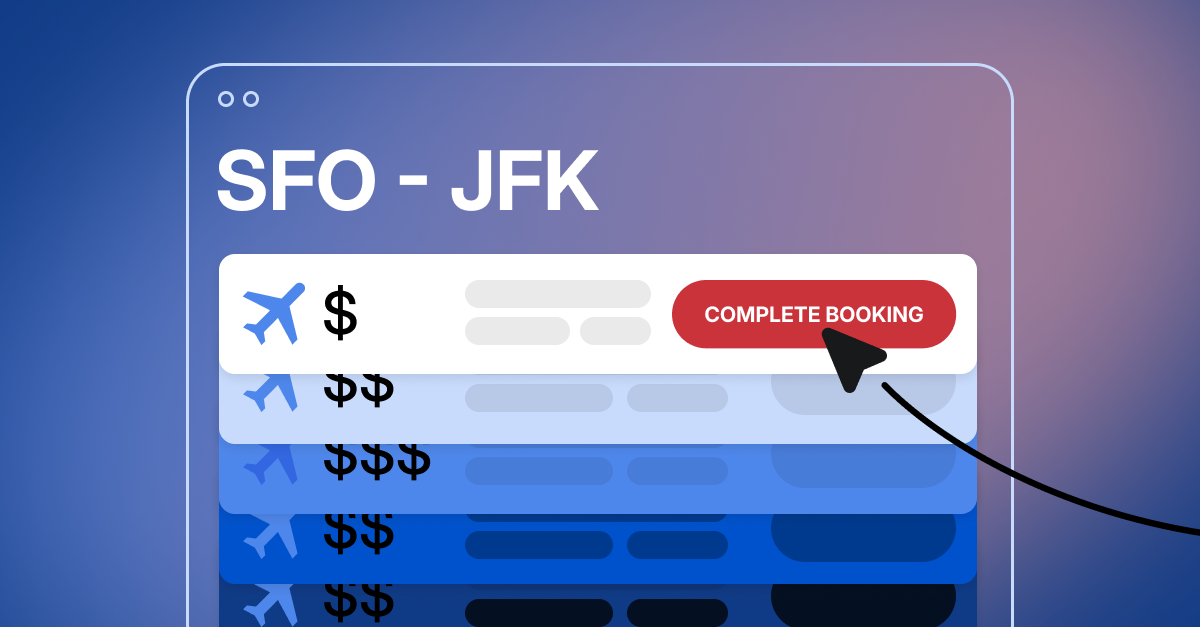
Every travel manager has heard the dreaded phrase: “I found it cheaper somewhere else.”
It’s the most common complaint in corporate travel. Better pricing outside an online booking tool (OBT) is now the top reason employees book outside their travel program, according to GBTA’s 2025 Perfect Business Trip study.
The same flight or hotel room can have different prices on an online travel agency (OTA), a travel provider’s website, your corporate OBT and the TMC. Each channel has its own inventory and pricing due to differences in technology and contracts.
Travel managers need a travel platform that can pull every relevant fare into their OBT and TMC while providing the best prices to travelers, so there’s no need to shop around.
Here’s why travelers find travel content cheaper outside your OBT, and what Spotnana is doing to eliminate this complaint once and for all.
Why channels carry different prices
Airlines and hotels offer the same seat or room at different prices depending on the distribution channel and associated contract. The travel industry calls this content fragmentation. Several factors contribute to this problem:
Content source integrations. OBTs can connect to different content sources, but the lowest-priced inventory may be available through a channel your OBT doesn’t reach.
To give travelers the broadest view of what’s actually available, OBTs need to pull in content from the widest possible range of sources, including direct integrations to travel providers and OTAs. But the content is controlled by the TMC having a contract to sell that content.
Over the past few years, nearly every major airline, hotel chain, car rental company, and OTA has developed an API that allows an OBT to access content with pricing that either matches or nearly matches what is available directly through their website.
Static rate plans vs. dynamic pricing. For many years, flights and hotel rooms were only available through distribution channels that supported a limited set of fares or rate plans filed in advance.
Now several airlines have developed NDC (New Distribution Capability) APIs that support dynamic, real-time pricing. Hotel chains are starting to offer similar capabilities.
The same direct API connections that deliver real-time pricing often provide the ability to access loyalty benefits, purchase ancillaries, automate booking changes, and improve servicing experiences. If your OBT only sees filed rates, you are likely missing out on significant savings as well as other benefits.
Channel economics and supplier agreements. Each distribution channel carries its own costs and contractual terms for travel providers. Travel providers often hold their best pricing for their websites and APIs, where they avoid distribution fees.
For hotels, OTAs use their scale to negotiate discounted rates, but those rates often come with restrictions like prepayment, no loyalty rewards points, or non-refundable terms that don’t suit corporate travelers.
If your OBT doesn’t include OTA rates or doesn’t make it easy to compare the payment terms and loyalty benefits available from each hotel content source, your travelers might prefer to book directly through channels that provide this information.
Negotiated rate confusion. When your travel program includes negotiated rates, those rates can carry negotiated value beyond a discounted price, such as priority boarding, free Wi-Fi, breakfast, room upgrades, status credits, and change flexibility.
Travelers comparing only the published rate can mistake the negotiated rate for a worse deal when it actually delivers more value. It’s important to assess how well your OBT is able to show travelers what’s included in an offer in a way that makes it easy to compare value, as well as price.
Hotel rate presentation. Hotel pricing is hard to compare apples to apples as different sites display taxes, resort fees, and government charges in different places, and prepaid versus pay-at-property terms change the effective cost.
Travelers need to be able to see all hotel rates presented in a consistent way when it comes to taxes, fees, and amenities. A traveler can pull up two browser tabs and find a “cheaper” rate that, after taxes, fees, and missing amenities, costs the company more.
Servicing complexity. Most TMCs are skilled at servicing travelers when they book through a limited set of content sources. Sometimes the best prices are available through channels that they aren’t able to service or will only service for an additional fee.
To reduce leakage, travel managers need to ensure that both their OBT and TMC are able to access the broad range of content sources that are available in the market.
The cost of leakage
Leakage happens when travelers book outside corporate policy or approved channels and remains a persistent issue: 67% of travel managers said air leakage grew or stayed the same year over year, and 81% reported the same for hotels, according to GBTA’s 2025 Perfect Business Trip study.
Research conducted by Spotnana and GBTA this year found that travel managers estimate 32% of hotel bookings happen outside of their travel program’s managed channels.
When travelers book your negotiated rates, they experience the savings and value your program worked to secure. In addition, these bookings help you achieve the commitments you make in agreements with travel providers.
Off-platform bookings cause you to miss savings opportunities, and they weaken your ability to negotiate deals with travel providers. Duty of care tracking can also be ineffective when a booking happens outside your system. If a traveler books on a consumer site, you likely won’t know where they are or how to reach them if something goes wrong.
Effective policy guidelines can reduce leakage, but don’t address the root cause: if the cheaper fare exists somewhere out there, your travelers will find it, and some will book outside your approved channels.
How Spotnana solves “I found it cheaper”
Spotnana is much more than an OBT. We have built a comprehensive travel platform with new, modern infrastructure that can pull in content from any source. Through the dozens of integrations we’ve developed to major airlines and hotel chains, your travelers are much more likely to see what they’d find on consumer sites without leaving your program’s managed channels.
Spotnana’s Content Engine consolidates and normalizes inventory from any source, including GDSs, NDC connections, direct API connections, low-cost carriers, hotel chains, and OTAs. All of this content is presented to your traveler in a single, unified shopping experience that addresses content fragmentation. We show rich content in an easy-to-understand display, making it easier for travelers to make accurate comparisons between different content options.
Spotnana has built deep, direct integrations to Booking.com and Expedia, delivering global hotel inventory alongside corporate rates inside our Online Booking Tool.
We also operate the widest array of deep, direct NDC integrations in the industry, surfacing airline-direct fares, ancillary bundles, and loyalty-aware offers that other platforms may not be able to access. Ryanair and easyJet show up alongside full-service carriers in the same display through Spotnana’s Kyte API integration, and several India-based airlines are available through our integration with Cleartrip.
Your negotiated rates appear alongside public fares and are marked with your company’s logo, so travelers can directly see when a policy-compliant choice is also the best price.
Spotnana supports the ability to “show but don’t allow booking,” which helps you avoid bookings you don’t want in your program while building trust with travelers that there is no need to shop around. Travelers see everything available, your program retains control, and comparisons happen with the traveler staying inside the OBT.
We not only make it easy to shop across a wide range of content sources, but we also enable travelers to manage their own trips and receive exceptional support from travel management companies (TMCs). Our content integrations support the full traveler journey from booking through to servicing. As a result, we provide advanced self-service capabilities for travelers and extensive servicing tools for travel agents.
Lastly, real-time analytics quantify your savings by source, route, and supplier through Spotnana’s Content Source Savings reporting, giving you the data to prove your program’s value.
Widest possible content inventory
If your travelers find cheaper fares outside your travel program, the issue is most likely the inability of your OBT or TMC to access content sources with the best prices.
If you never want to hear “I found it cheaper somewhere else” ever again, make the switch to a modern travel platform that has been built from the ground up to integrate with any source of content.
Want to see how Spotnana delivers the widest selection of inventory with the best available prices? Request a demo today.
Written by

-
 What is content fragmentation in travel?Content fragmentation has become one of the defining challenges in corporate travel today. In the early days of travel management companies (TMCs), a travel manager could be confident that their TMC had access to...

-
 Stealth travel limits visibility to those who need to knowCorporate travel can be highly sensitive. Perhaps a CEO needs to meet with a board candidate, or a mergers and acquisitions team needs to negotiate a deal in person without spreading rumors. If travel...