

Podcast: Eric Bailey on purposeful travel, transparency, and trust


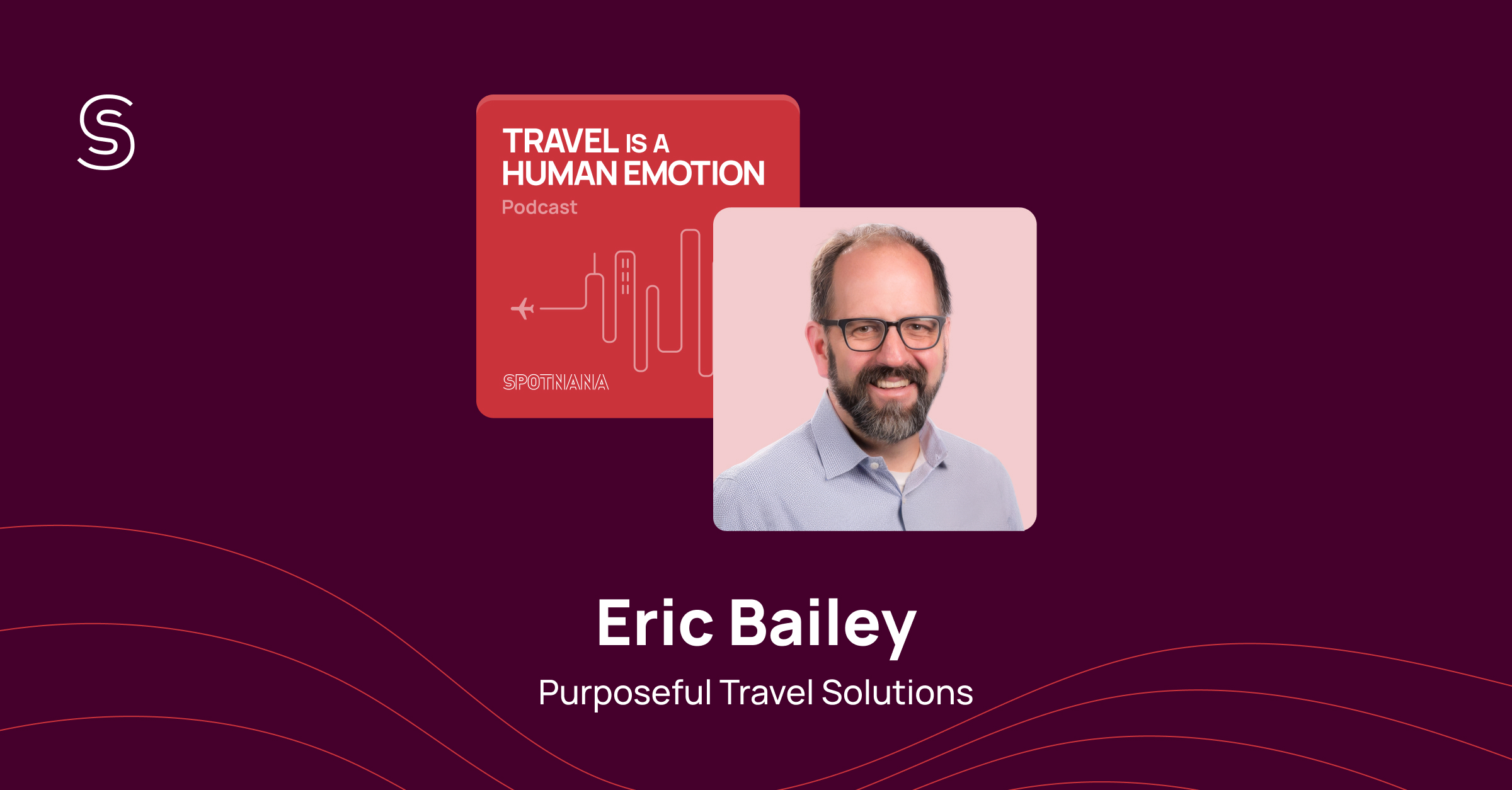
Eric Bailey managed Microsoft’s travel program for nearly 20 years, overseeing spend that at one point exceeded $1 billion, and used his position to push the wider industry forward. Seeing an industry drifting on inertia, he convened buyers and suppliers to produce two foundational documents, the Corporate Travel Innovation Manifesto in 2018 and the Corporate Travel with Purpose Platform in 2022.
For the 26th episode of The Travel Is a Human Emotion Podcast, Justin Schuster, SVP of Marketing at Spotnana, spoke with Eric Bailey, Owner and Managing Director of Purposeful Travel Solutions, about where the industry has delivered on the manifesto and where gaps still remain.
Trust and transparency
Transparency was one of the manifesto’s central themes, and it remains a live debate. In practice, Bailey said, transparency means “show us the money.” Every new executive learning about Microsoft’s travel program received two documents from him: where the money flows, and where the data goes.
A more recent concern is that commissions and supplier payments make up 60% to 75% of revenue at some agencies, leading to questions about who the TMC ultimately serves.
“From the buyer’s perspective, we’d rather get a discount up front than have this money go somewhere in the background,” Bailey said. Travel management companies (TMCs) deserve a fair profit, he added, but “in a model where it looks like somebody should be making money and they’re not, that’s where transparency is needed.”
Personalization
Asked where the industry has made progress, Bailey pointed to payments and personalization, with a caveat. The technology has caught up, but booking tools still rank options in ways that ignore how people decide.
Research Bailey’s team ran a decade ago found travelers flying Seattle to Washington, DC chose Alaska 75% of the time, while those flying the reverse direction chose United 75% of the time. Clear patterns, he said, still go largely unnoticed.
Where personalization has arrived, however, it lives in silos. “My flight is becoming more personalized, but that is not changing my hotel experience necessarily,” Bailey said. “And when I land, I’m still not being given a ground transportation option.”
The return on purposeful travel
Bailey defines purposeful travel by what a trip produces. “Corporate travel is not about getting onto a plane or going to a hotel or even planning a meeting. It’s about the connections that you make when you’re there,” he said.
In a world of escalating travel costs, companies need a way to understand the return on investment (ROI) for travel. “We know how much it costs. That we’ve known for years and years. But the return on it, what are the different things that we can get back, and how do we maximize that return?” Bailey said.
Some of that return is measurable, even when a sale takes years and 100 people to close. “Can you say that from a trip, there were 10 new relationships built, of which five of those are followed up with monthly by email or a phone call? That’s actually measurable,” Bailey said.
The pandemic also reshaped his view of who gets to participate. A Microsoft developer event planned for 5,000 in-person attendees in Seattle moved online and drew 197,000. “Maybe we’re not trying to be exclusionary in corporate travel, but I think we kind of are,” Bailey said. “When we say the only way you get this content is by coming here, is that really the best way to do it?”
Boosting sustainability
Bailey started working on environmental reporting at Microsoft around 2008, when travel was a third of the company’s carbon footprint. It remains a sizable share at many companies.
One finding gave him a practical lever. On a cost-per-mile basis, a business class flight carries roughly three times the carbon of a coach ticket and roughly three times the cost. “If you cut budget, you cut carbon almost the exact same amount,” Bailey said.
Asked why sustainability has faded from the conversation, Bailey pointed to “the difference between the gestures and the impact.” Better air traffic control routing could cut emissions by 5% to 7%, but gets no attention until air traffic control works reliably. Data sharing offers a nearer-term win: if 10 colleagues who don’t know each other are all registering for the same conference, better coordination might mean sending five.
Trust and the two-page policy
Bailey sees blended travel as a potential remedy for the stress of business travel. “We look at employee stress as a negative potential of travel, so why don’t we look at employee enjoyment as a positive of travel?” he said. On one of his last business trips, to Nice, he added a day of canyoning, hiking, and go-karting for the cost of one hotel night.
Bailey’s answer to the worry that people will travel for personal reasons is to control budgets well and change what managers review. “Maybe instead of an expense report, we really need a success report,” he said. “If you can’t trust them to make a $3,000 trip decision, I think you have worse problems.”
This philosophy shaped Microsoft’s travel policy, which was only two pages long, yet used across 120 countries. “It basically says, use the agency, use the card, fly business class only if you have this approval,” Bailey said. Long policies are worthless, he argues, because “trying to make a policy so clear that you make it perfect, you inherently make it imperfect and easier to game.”
Travel as human connection
Bailey spent two decades measuring travel by the numbers. His newest project runs the other direction: hand-inked posters, made with his daughter, a printmaker. Created in the tradition of the old TWA and Pan Am prints, they are meant to stir the nostalgia of travel to business destinations and events. “It’s so not AI,” he said. “I love the tangible side of it.”
The tangible side of travel is something everyone understands and nobody has fully measured, Bailey said. Ask people about the first meal on their first international trip, and most can describe it. Ask what they ate last Thursday, and nobody can.
This is why he wants corporate travel to push people somewhere unfamiliar. “Taking us out of our comfort zone, putting us into something else, is going to create more value,” Bailey said. “We’re going to remember those conversations more. We’re going to be more creative. We’re going to create better bonds with people. We’re going to trust each other more.”
Written by

-
 Introducing a richer seat experience in SpotnanaChoosing the right seat makes a meaningful difference to a traveler’s journey. Travelers want to know where a seat is on the aircraft, what features it offers, and how its experience compares with other...

-
 Approve travel in seconds with Spotnana’s approval enhancementsTravel approvals are time-sensitive by nature. Yet standard approval processes can be lengthy, multi-step, and completed across various platforms costing companies real money. We're committed to streamlining travel management at Spotnana. To that end,...